De la ferraille au profilé : répondre à la demande mondiale d’aluminium bas carbone
June 18 , 2026
Porté par des mandats mondiaux de décarbonation comme le CBAM européen, le secteur manufacturier évolue fortement vers des solutions d’aluminium à faible teneur en carbone. Pour rester compétitifs, les extrudeurs d’aluminium intègrent des systèmes de recyclage en boucle fermée qui transforment directement les profilés d’aluminium usagés en billettes d’aluminium de haute pureté, réduisant l’empreinte carbone jusqu’à 95 % par rapport à la production primaire par fusion.
La course mondiale à l’aluminium vert Alors que nous progressons en 2026, l’industrie mondiale de la transformation des métaux connaît un changement sismique. Portée par les accords climatiques internationaux, les cadres de taxation du carbone (tels que le Carbon Border Adjustment Mechanism - CBAM de l’UE) et les objectifs agressifs de neutralité carbone des principaux constructeurs automobiles et fabricants de panneaux solaires photovoltaïques, la demande en aluminium primaire diminue. À la place, le marché mondial exige de « l’aluminium vert ».
La production d’aluminium à partir de la bauxite est un processus extrêmement énergivore. À l’inverse, le recyclage des déchets d’aluminium post-industriels et post-consommation ne nécessite que 5 % de cette énergie, ce qui entraîne une réduction stupéfiante de 95 % des émissions de carbone. Pour les extrudeurs et les fonderies d’aluminium, la mise en place d’un véritable écosystème de recyclage en boucle fermée n’est plus seulement un objectif environnemental — c’est une stratégie commerciale essentielle pour contourner les barrières commerciales et obtenir des contrats internationaux premium.
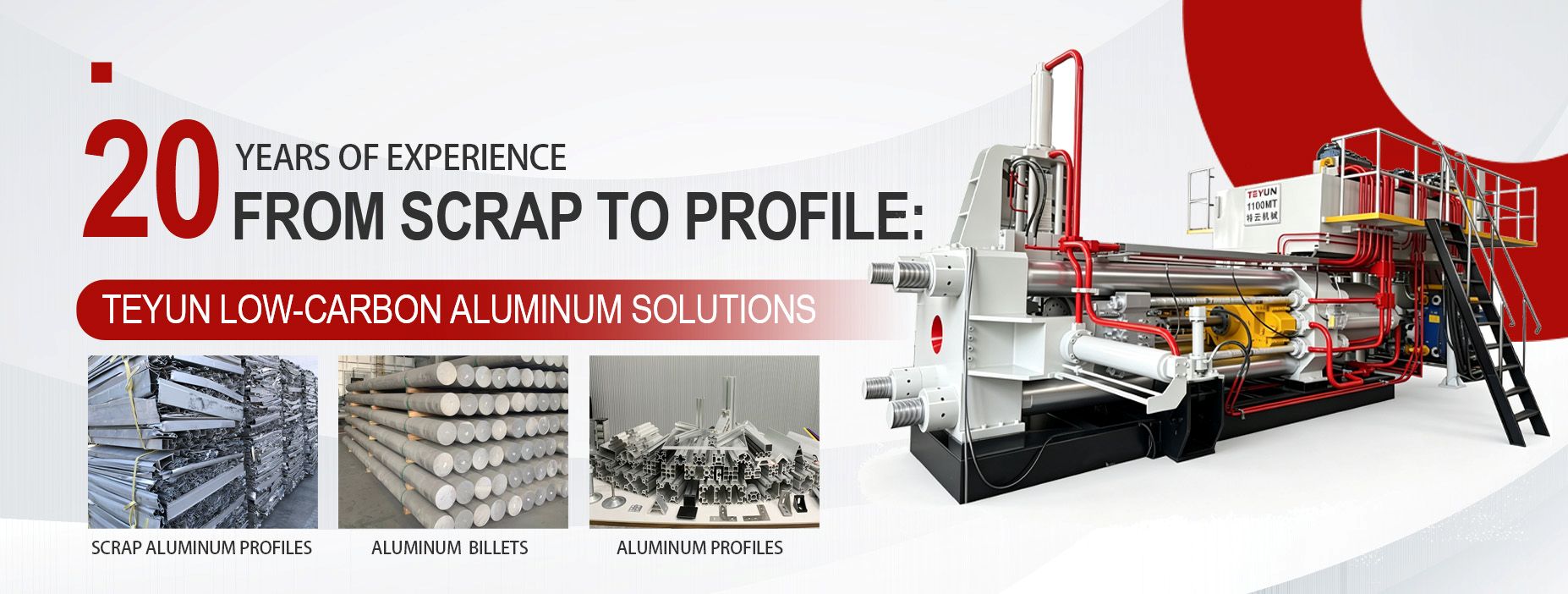
La solution en boucle fermée « du déchet au profilé » Pour aider les entreprises mondiales à naviguer cette transition verte, Teyun s’appuie sur 20 ans d’expertise technique pour fournir des solutions complètes et intégrées solutions d’aluminium à faible teneur en carbone. Ce flux de travail sophistiqué comble le fossé entre les parcs de récupération chaotiques et la fabrication de précision, offrant un cycle de production fluide en trois étapes :
-
Traitement des profilés d’aluminium usagés : Le processus commence par la collecte et le tri. Les matériaux volumineux, contaminés ou en vrac profilés d’aluminium usagés sont prétraités à l’aide de technologies de compactage à haute pression ou de broyage afin d’optimiser la densité, d’éliminer les poches d’air et d’éliminer les contaminants de surface.
-
Refusion des billettes d’aluminium : Le déchet traité est ensuite introduit dans des fours de refusion et de coulée à haut rendement. Comme le déchet est pré-densifié, la combustion et l’oxydation dans le four sont considérablement réduites, ce qui permet d’obtenir un rendement métallurgique exceptionnel. Le métal en fusion est coulé en billettes d’aluminium.
-
Extrusion des profilés d’aluminium finis : Enfin, ces billettes recyclées de haute pureté sont introduites dans des lignes d’extrusion avancées pour fabriquer de nouveaux profilés structurels profilés d’aluminium prêts à être utilisés dans les véhicules électriques, la construction et les infrastructures d’énergie verte.
Un héritage de 20 ans de confiance en ingénierie La transition vers un modèle de fabrication à contenu recyclé nécessite des machines robustes et fiables, capables de maintenir une pureté stricte des alliages et de traiter diverses entrées de déchets sans temps d’arrêt fréquent. Avec deux décennies de R&D dédiée aux technologies de recyclage des métaux et de compactage, Teyun fournit les bases industrielles robustes nécessaires pour atteindre une production continue à haut volume.
Investir dans un système en boucle fermée « scrap-to-profile » permet aux transformateurs mondiaux d’aluminium de sécuriser leurs chaînes d’approvisionnement en matières premières, de réduire considérablement les coûts d’approvisionnement et de fournir les produits certifiés à faible teneur en carbone que demandent les acheteurs mondiaux modernes.

 English
 русский
 español
 العربية
 日本語
日本語 Tiếng Việt
 中文
中文


 Adresse : Mingjue Industry Park, Lishui District, Nanjing City, Jiangsu Province



 Réseau IPv6 pris en charge